Early Underbite Correction: Using a Face Mask to Fix an Anterior Crossbite
Why an underbite should be assessed early, how a face mask works during growth, and what parents can expect from two-phase treatment.

What is an anterior crossbite?
An anterior crossbite happens when one or more upper teeth bite behind the lower teeth, the reverse of the normal position. When the whole upper arch sits back relative to the lower arch, it's called a Class III malocclusion, or an underbite.
This condition can have several origins:
- Skeletal: an underdeveloped maxilla (upper jaw), a mandible (lower jaw) that is too far forward, or a combination of both
- Dental: the upper incisors are tipped back or the lower incisors are tipped forward
- Functional (pseudo-Class III): early tooth contacts make the lower jaw slide forward when the mouth closes
- Genetic: heredity plays a big role. If a parent has a Class III bite, the child's risk is significantly higher
An important point: most Class III malocclusions in children involve an underdeveloped upper jaw rather than an oversized lower jaw. That's good news, because it's exactly what a face mask can help correct.
Why act early? The window of opportunity
In orthodontics, early treatment of an anterior crossbite is one of the situations where timing makes all the difference. The ideal window is between ages 7 and 10, and that's no accident.
What's happening in your child's bones
The upper jaw is connected to the rest of the skull by growth sutures (zygomaticomaxillary, pterygopalatine, frontomaxillary and the midpalatal suture). In a child aged 7 to 10, these sutures are still open and responsive to orthopedic forces. They gradually begin to fuse with age.
After puberty (around 12 to 14 for girls and 14 to 16 for boys), the sutures are largely fused, and changing the skeleton with orthopedic forces becomes unpredictable, or even impossible. Treatment is then limited to dental camouflage or jaw surgery.
Why not wait?
- A Class III malocclusion is one of the few orthodontic conditions that never corrects itself, and it tends to get worse with growth
- The lower jaw keeps growing longer than the upper jaw (sometimes into the early twenties in boys), which widens the gap between them
- An untreated crossbite can lead to early wear of the lower incisors, gum recession, jaw joint (TMJ) problems and a real psychosocial impact
The American Association of Orthodontists (AAO) recommends a first orthodontic assessment by age 7, partly to catch Class III problems.
The face mask: how does it work?
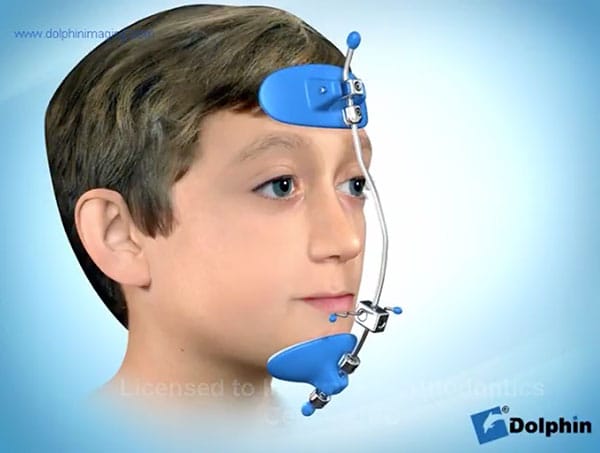
A face mask (also called a protraction face mask or reverse-pull headgear) is an orthopedic appliance worn outside the mouth that literally pulls the upper jaw forward during growth.
The appliance
It's made up of:
- A forehead pad and a chin cup joined by a vertical metal frame
- Elastics (400 to 600 grams of force per side) that connect hooks on an appliance inside the mouth (usually a palatal expander bonded to the upper molars) to the crossbar of the mask
How it works
The elastics apply a forward and downward pulling force on the upper jaw. This force:
- Stimulates bone formation at the sutures around the upper jaw, moving the maxilla forward for real (a skeletal effect)
- Brings the upper teeth forward (a dental effect)
- Rotates the lower jaw slightly down and back, which helps correct the Class III
Studies show that roughly 30 to 50% of the correction is skeletal (true forward movement of the upper jaw) and 50 to 70% is dental. Forward movement of the upper jaw typically ranges from 1.5 to 3 mm depending on the case.
The treatment protocol
Combining rapid palatal expansion with a face mask is considered the standard treatment for early Class III.
Why start with expansion?
Rapid palatal expansion (RPE) before or alongside the face mask loosens the sutures around the upper jaw, making it more responsive to forward pull. Even in patients whose jaw isn't too narrow, expansion serves a mechanical purpose by making it easier to move the upper jaw forward.
The stages of treatment
Phase 1: Palatal expansion (2 to 4 weeks)
- A rapid palatal expander (Hyrax or Haas type) is cemented to the upper molars
- Activation: 1 to 2 turns a day for 2 to 4 weeks
- Goal: 5 to 8 mm of expansion to loosen the sutures
Phase 2: Face mask (6 to 12 months)
- The mask is fitted and the elastics are hooked onto the expander
- Force: 400 to 600 grams per side
- Wear: 12 to 14 hours a day (evenings and overnight)
- Adjustments at the clinic every month or two
Phase 3: Retention and overcorrection
- Treatment aims for deliberate overcorrection: a positive overjet of 3 to 5 mm and a molar relationship slightly toward Class II
- Why? Continued lower jaw growth during the teen years will "use up" this overcorrection
- A Class III chin cup or part-time mask wear can be used for retention
Total length
The active phase lasts 6 to 12 months, followed by 6 to 12 months of retention. Most patients will need a second phase of treatment with braces or aligners once all the adult teeth are in (around 12 to 14) to finish aligning the teeth.
Success rates: what the research says
Studies published in the orthodontic literature are reassuring:
- Short-term success (crossbite corrected and positive overjet): 80 to 90%
- Long-term stability (correction maintained through the teen years without surgery): 65 to 75%
- Patients who eventually need surgery: about 20 to 35%, mainly those with a severe skeletal discrepancy at the start, a strong genetic pattern of lower jaw growth, or treatment started late
Studies by Ngan et al. (1996-1997) showed an average forward movement of the upper jaw of 1.5 to 2 degrees (SNA), while Baccetti, Franchi and McNamara (1998) confirmed that early treatment produces significantly greater skeletal effects than late treatment.
Key message: even when surgery does turn out to be necessary, early treatment often reduces how extensive that surgery needs to be.
What happens without treatment?
If a skeletal Class III malocclusion is left untreated during the growth years:
- The discrepancy gets worse during the pubertal growth spurt
- Functional problems appear: difficulty biting and chewing, abnormal tooth wear, TMJ problems
- The esthetic impact can be significant: a concave profile, a prominent chin, a flattened midface
- Gum recession can develop on the lower front teeth
Treatment in adulthood is then limited to two options:
- Orthodontic camouflage (compensating with the teeth using braces), only for mild cases
- Orthognathic surgery (Le Fort I upper jaw advancement, with or without lower jaw setback), which involves general anesthesia, 2 to 3 years of total treatment, 4 to 6 weeks of recovery and significant costs
Early treatment with a face mask at age 7 to 10 can potentially avoid jaw surgery at 18 to 20.
Signs for parents to watch for
See an orthodontist if you notice that your child has:
- Lower teeth that bite in front of the upper teeth, the most obvious sign
- A flat or concave profile (seen from the side, the middle of the face looks "hollow")
- A chin that looks prominent compared with the rest of the face
- A lower lip that sticks out past the upper lip
- Trouble biting into food (can't bite through a sandwich with the front teeth)
- Speech difficulties (a lisp, trouble with certain sounds)
- A family history of underbite or jaw surgery
- Mouth breathing or snoring (which can be linked to an underdeveloped upper jaw)
Newer options
Orthodontic research keeps improving the treatment options:
Bone-anchored miniplates
Developed by De Clerck et al. (2009, 2012), titanium miniplates are placed surgically in the upper and lower jaws. Class III elastics between the plates provide a continuous bone-to-bone force, which avoids unwanted effects on the teeth and gives more forward movement of the upper jaw (4 to 7 mm). This approach can work even in older patients (11 to 14).
Temporary anchorage mini-screws
Mini-screws placed in the palate or the infrazygomatic crest serve as anchors for forward pull. Less invasive than miniplates, and especially useful in moderate to severe cases.
Class III functional appliances
For mild or functional cases, appliances such as the Frankel III or a reverse twin block can be used. They are generally less effective for true skeletal Class III, but suitable for dental or functional cases.
The reality of two-phase treatment
It's important for parents to understand that the face mask is Phase 1 of treatment. Its goal is skeletal correction during the growth window. Most patients will need a Phase 2 of full orthodontic treatment with braces or aligners once the adult teeth are in (around 12 to 14) to finish aligning the teeth.
The goal of Phase 1 isn't cosmetic perfection. It's to correct the skeletal problem while that's still possible without surgery.
Cooperation: the key to success
Face mask success depends heavily on the child's cooperation. The appliance has to be worn 12 to 14 hours a day for several months. Studies show that children under 10 are generally more cooperative than teenagers, one more reason to favour early treatment.
At the clinic, we take the time to explain how the appliance works in a way that suits the child's age. When young patients understand why they're wearing it and can see their progress, motivation follows naturally.
Does your child have a crossbite?
At Dr. David Benguira's Orthodontic Centre, we offer a free consultation to assess your child. With our 3D imaging (CBCT) and intraoral scanners, we can make an accurate diagnosis and determine whether face mask treatment is appropriate.
The earlier the diagnosis, the better the treatment options. Don't wait: the growth window doesn't stay open forever.
Our clinics
Queen Mary Orthodontic Centre (Montreal)
3766 Queen Mary
By appointment
Rive Nord Orthodontic Centre (St-Eustache)
464 rue du Parc, suite 122
By appointment
Contact us
Montreal: (514) 484-3718
St-Eustache: (450) 983-4233
Email: drdavid@monorthodontiste.org
Website: www.monorthodontiste.org
Scientific references:
- McNamara JA (1981). An orthopedic approach to the treatment of Class III malocclusion in young patients
- Ngan P, Hagg U, Yiu C (1996-1997). Treatment response to maxillary expansion and protraction
- Baccetti T, Franchi L, McNamara JA (1998). Treatment and posttreatment craniofacial changes in early vs. late treatment
- De Clerck HJ et al. (2009, 2012). Bone-anchored maxillary protraction with miniplates
- Mandall N et al. (2010, 2016). RCT on early facemask treatment outcomes
- Foersch M et al. (2015). Systematic review of maxillary protraction efficacy