Baby Teeth That Won't Fall Out: Remove Them or Keep Them?
A baby tooth that hangs on often hides a missing or stuck adult tooth. Sometimes we remove it, sometimes we keep it for years. Here's what makes the difference.


A baby tooth that won't fall out is almost always hiding something underneath: an adult tooth that is missing, stuck or running late. Before deciding whether to remove it or keep it, we look at an X-ray. Sometimes we take it out quickly, sometimes we protect it for years.
"He's 13 and he still has a baby tooth. Should we pull it?" We hear this question often, from parents and from dentists alike. The honest answer is: it depends on what's underneath. And sometimes the best thing to do is precisely to leave it alone.
Why a baby tooth stays put
Normally, the adult tooth pushes up from below and dissolves the root of the baby tooth. When nothing is pushing, the baby tooth has no reason to leave. The most common causes:
- The adult tooth doesn't exist. This is called agenesis. After wisdom teeth, the teeth most often missing are the lower second premolars and the upper lateral incisors. It often runs in families.
- The adult tooth is there, but stuck or pointing the wrong way. This is common with canines.
- It's simply late. Some children have a slower dental timetable, especially if their overall growth is behind schedule.
- The baby tooth is fused to the bone (ankylosis). It seems to "sink" because the neighbouring teeth keep coming up and it no longer follows them.
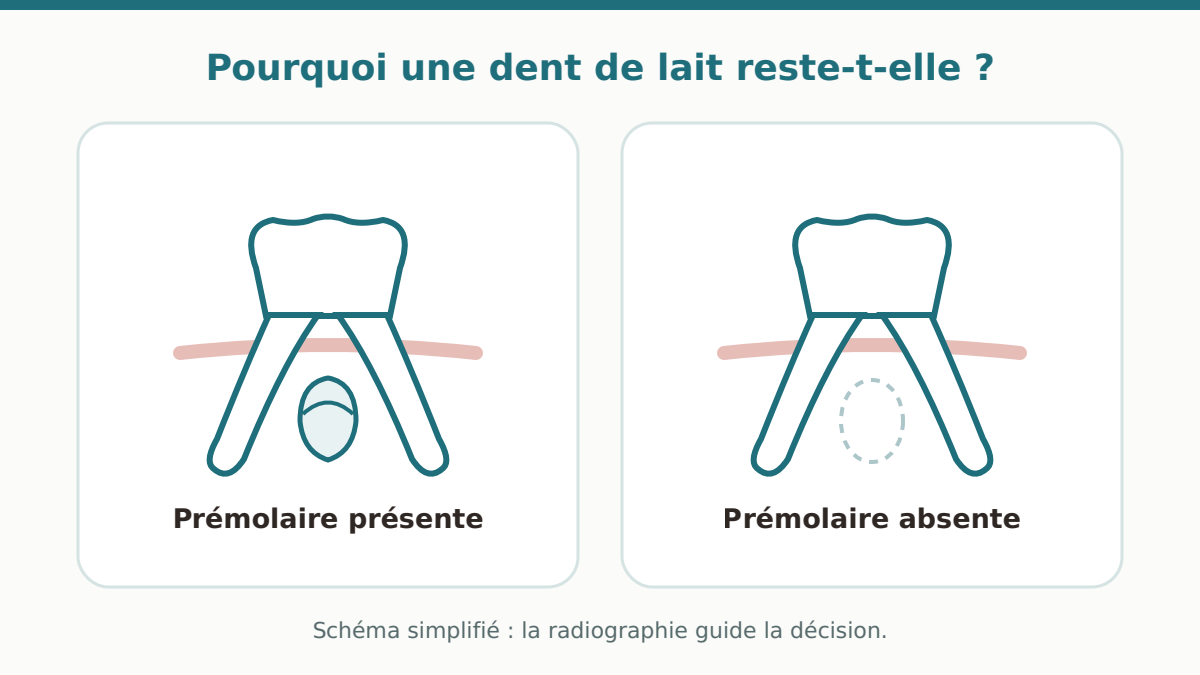
X-ray first, decision second
We never decide by eye. A panoramic X-ray tells us whether there is an adult tooth, where it is, and what condition the roots of the baby tooth are in. That's what guides the next step.
When we remove it
If the adult tooth is present and well oriented but blocked by the baby tooth, removing the baby tooth often clears its path. The same goes for a baby tooth that is ankylosed and starting to sink: left too long, the neighbouring teeth tip into the space and the bone doesn't develop properly there. The right moment is chosen carefully, and it's often coordinated with your dentist.
When we keep it
When the adult tooth is missing, a healthy baby tooth with a solid root, well lined up with its neighbours, makes an excellent "space keeper." Some last into adulthood, sometimes for a very long time. It preserves the bone and the space, which keeps every option open for later.
We simply monitor it: its root, its height compared with the other teeth, how firm it is.
And when a tooth is missing for good?
There are roughly two paths, and the choice depends on the face, the bite, the child's age and what the family wants:
- Close the space with braces, by moving the neighbouring teeth forward.
- Keep the space open for a future replacement tooth (an implant or a bridge), placed only once growth is complete. During the years of waiting, orthodontics prepares and maintains the right width.
Neither option is better in general. We discuss them openly with you and, when helpful, with your dentist or a periodontist.
The takeaway
A baby tooth that overstays its welcome isn't urgent, but it isn't something to ignore either. One X-ray is enough to know what's going on and decide calmly. The sooner you know, the more choices you have.
Related reading
- Impacted canine: why a tooth won't come in, and how we help it
- Why age 7 is crucial for your child's first orthodontic visit
The first orthodontic consultation is free. If your dentist has a recent X-ray, bring it along or ask them to send it to us. Phone: 450-983-4233 · our contact page