Impacted Canine: Why a Tooth Won't Come In, and How We Help It
A canine that won't come in is more common than you think. How we spot it early and how we help it into place.

A canine that doesn't come in is nothing unusual. It can often be spotted around age 9 or 10, and the earlier it's noticed, the simpler the options. When it stays truly stuck, we uncover it with a minor surgery and guide it gently into place.
Every year, parents come to see us a little worried. The dentist noticed something on an X-ray, or their child is 12 and the adult tooth still hasn't shown up. The word "impacted" sounds scary. Yet it's a situation we know well: since 2020, our clinic has guided more than a hundred exposures of impacted teeth, and the vast majority involved upper canines.
Why the canine, of all teeth?
The upper canine makes the longest journey of any tooth in the mouth. It forms very high up, close to the nose, and travels down for years before it erupts, usually around age 11 or 12. It's also one of the last front teeth to arrive. If space is tight, if its path drifts slightly, or if the tooth next to it (the lateral incisor) is small or missing and no longer acts as a guide, it can get stuck on the way.
About 1 to 2 people in 100 have an impacted upper canine. In most cases the tooth is stuck on the palate side, and it often runs in families. If a brother, a sister or a parent had the same problem, it's worth mentioning.
The signs we watch for
- Around age 9 or 10, you can normally feel a small bump above the baby canine, on the cheek side. When we can't feel it, we take a closer look.
- The baby canine isn't loose at all at 11 or 12, while the other baby teeth are gone.
- A clear difference between the left and right sides.
- A lateral incisor that is small, shaped like a grain of rice, or missing.
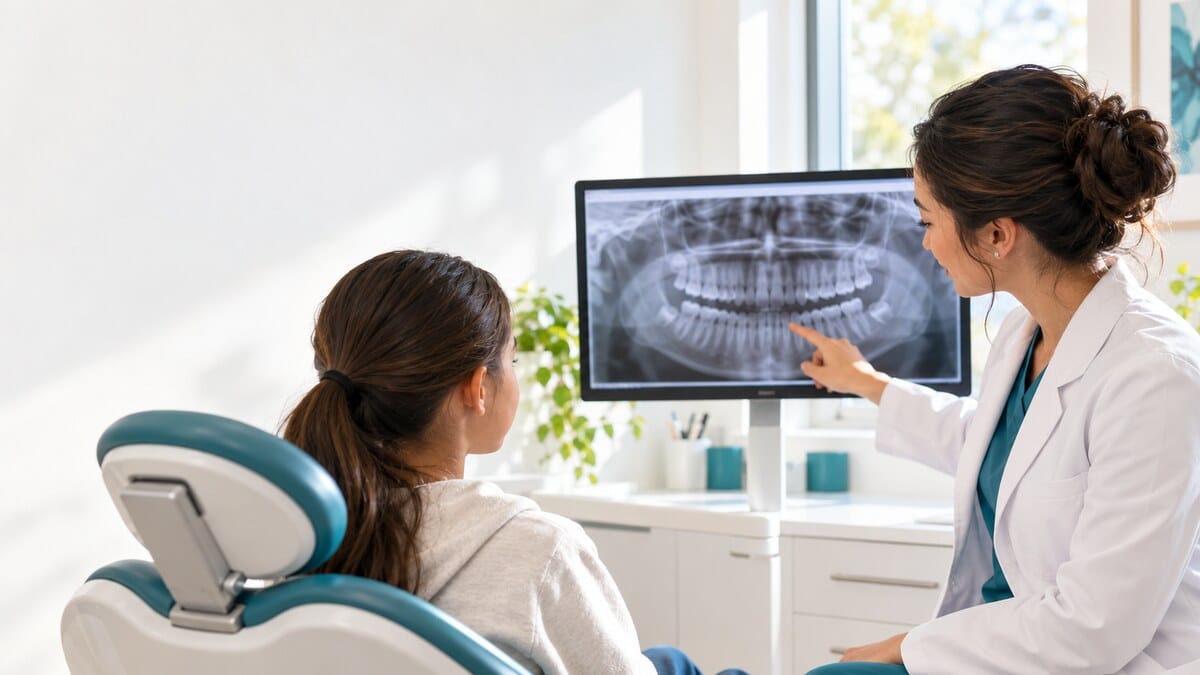
None of these signs is a certainty. A panoramic X-ray shows where the tooth is and which way it's growing. When needed, 3D imaging pinpoints its position relative to the neighbouring roots.
When we catch it early: sometimes clearing the path is enough
This is one of the good reasons to have a child assessed around age 7 or 8. If we spot a canine heading off course early enough, removing the baby canine at the right time is often enough for the adult tooth to correct its path on its own. We can also create a little space with an appliance. It isn't guaranteed, but it avoids a lot of surgeries.
When it stays stuck: exposure and traction
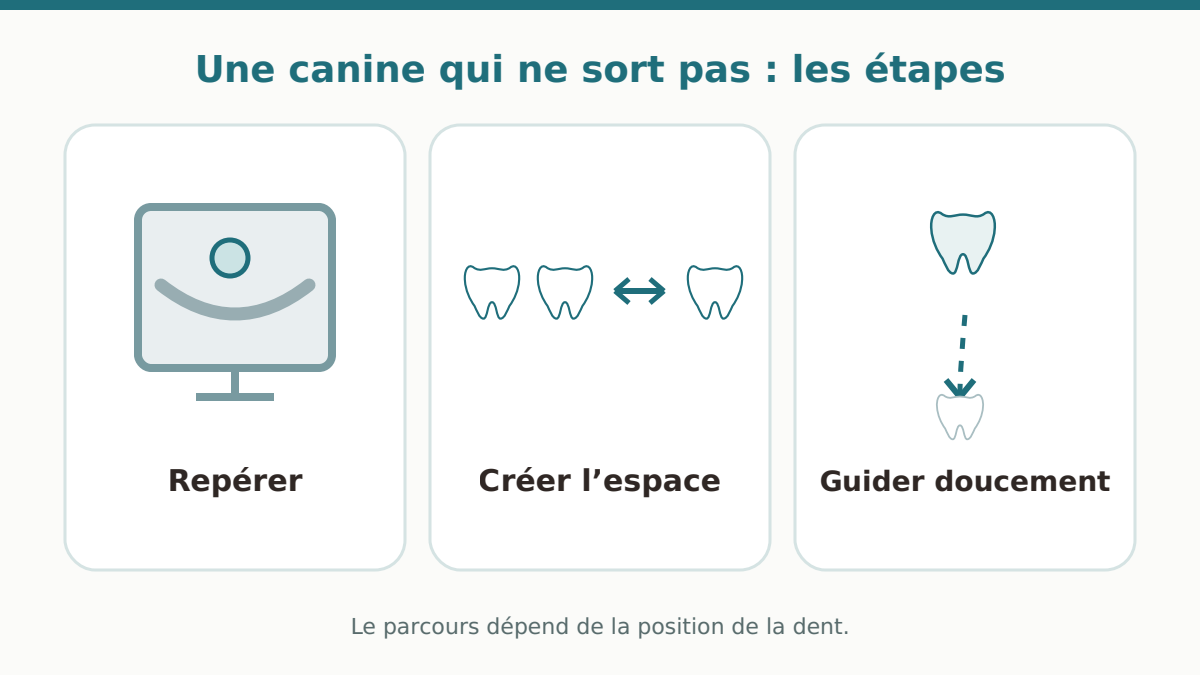
If the tooth can't come in on its own, we help it in two stages.
First, space. We make room in the arch with braces, so the canine has somewhere to go.
Then, exposure. An oral surgeon or a periodontist uncovers the crown of the tooth under local anesthesia and bonds a small button to it, attached to a tiny chain. The procedure is short. Most children are back at school the next day or the day after, with some discomfort that is easy to manage.
Finally, traction. At each visit, we pull very gently on the chain to bring the tooth toward its place. This is the longest part: depending on how deep the tooth is and its angle, it takes several months. We never force it. A light, steady force is what protects the root of the canine and those of the neighbouring teeth.
What if we do nothing?
An impacted canine can sit quietly for a long time. But it can also damage the root of the incisor next to it by pushing against it, with no symptoms at all. That's why we prefer to monitor it with X-rays rather than wait. In rare cases, when the tooth is too poorly positioned, we discuss other options with the family. Every situation is decided case by case.
What we often tell parents
An impacted canine isn't a failure, not on your part and not on your child's. It's a question of trajectory. What makes the difference is when it's spotted. An assessment around age 7 or 8, followed by monitoring of growth, gives us time to act simply.
Related reading
- Baby teeth that won't fall out: remove them or keep them?
- Why age 7 is crucial for your child's first orthodontic visit
- CBCT in orthodontics: the 3D X-ray
The first orthodontic consultation is free, in Saint-Eustache and in Montreal. Call us at 450-983-4233 or reach us through our contact page.