The Hyrax Expander Explained for Parents
Turning the key, the pressure, the gap that opens between the front teeth: a parent's guide to getting through the weeks of expansion.

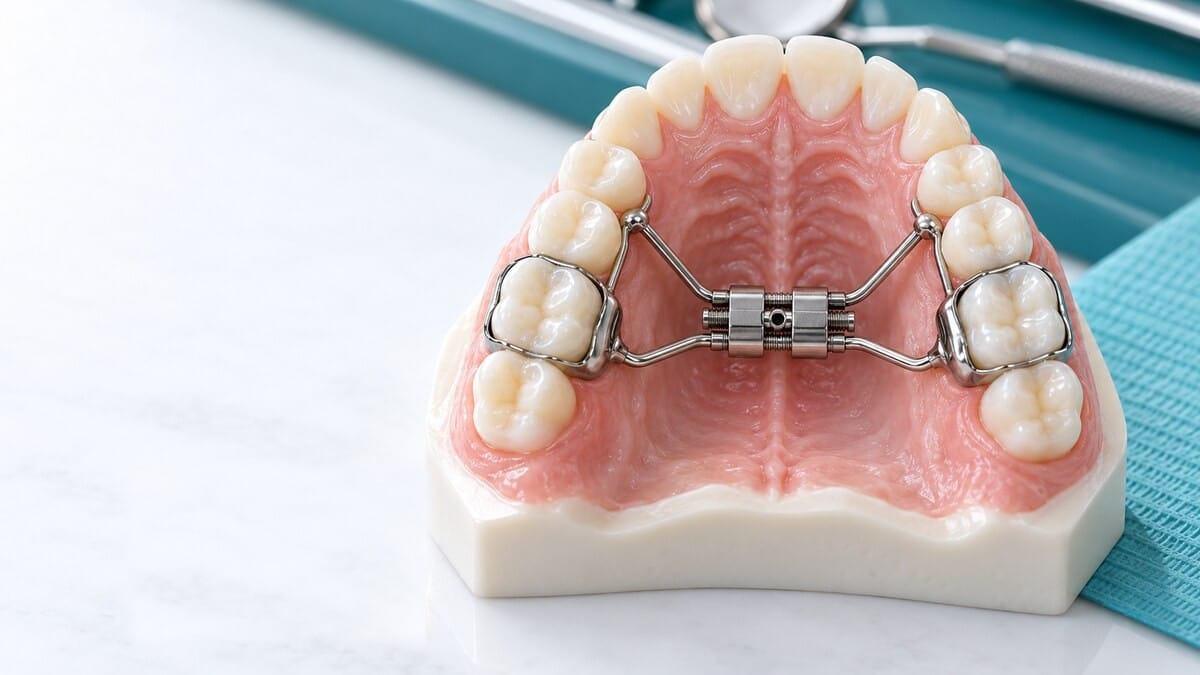
An expander widens the upper jaw while a child is still growing. A few days to get used to it, a small key to turn at home, and a gap that opens between the front teeth: that's normal, and it's actually a sign the appliance is doing its job.
Your child has just received an expander, often called a Hyrax. Or it's been suggested and you're wondering what to expect. Here's what we explain to families, along with the questions we're asked most often.
What does it do?
In some children, the upper jaw is too narrow. You can see it in a crossbite (the upper teeth close inside the lower ones), a lack of room for the adult teeth, or a high, narrow palate. During childhood, the two halves of the palate are still joined by a seam, called a suture, that hasn't fused yet. The appliance gently spreads them apart, and new bone fills in the gap. That's why we do it during growth: later on, the suture fuses and expansion becomes much more complicated.
Fitting day and the first few days
The appliance is bonded to back teeth. Fitting it doesn't hurt. For the first few days, the tongue explores this new object, speech may be a little lispy, and your child will produce more saliva. Everything usually settles within a few days. Reading out loud helps a lot.
The key at home
In the middle of the appliance there's a small screw with a hole. You insert the key and push it toward the back of the mouth, for the number of turns we've given you. We'll show you how at the clinic before you leave.
- Do it at the same time every day, in good light, with your child's head tilted back slightly.
- After the turn, the next hole should be visible. That's your checkpoint.
- Mark each turn on the calendar we give you. If you miss one, don't double up the next day: call us.
Right after the turn, children often feel pressure toward the nose, the cheekbones or between the eyes. It fades within a few minutes.
The gap between the front teeth
This is the question we get most often. After a few days of turning, a gap appears between the two upper front teeth. Parents worry, which is completely understandable.
It's actually good news. The gap shows that the two halves of the palate really are separating. Once the turns are finished, it gradually closes on its own over a few weeks, because the gums draw the teeth back toward each other. If a gap remains, we close it later with braces.
Eating and brushing
- Avoid sticky foods (caramel, gum, gummies) and very hard ones (ice, whole nuts, hard candy). Cut food into small pieces.
- The first meals are easier with soft foods.
- Food can get trapped under the appliance. Rinse with water after every meal, ideally with a small syringe, and brush well around the bands.
How long does it take?
The turning phase lasts only a few weeks. After that, the appliance stays in place for several months without any more turning, while the new bone firms up. This step is essential: removing the appliance too early would let the jaw partly close again.
When to call us
- The appliance moves or comes loose.
- Strong pain that lasts, or irritation that isn't getting better.
- You can no longer see a hole in the screw, or you're unsure how many turns have been done.
For minor issues in the meantime, our emergencies page covers the right first steps.
Related reading
- Palatal expansion in children: why and how?
- Snoring, tonsils and orthodontics: the link in children
- Orthodontic emergencies: what to do in the meantime
Call us at 450-983-4233. And if you're wondering whether your child might need expansion, the first orthodontic consultation is free. Book your first consultation.